

For gun owners who have spent years navigating forms, fees, and long waits to acquire certain National Firearms Act (NFA) items, ATF’s latest guidance marks a major shift. Effective October 9, 2026, the agency says it will no longer enforce specified NFA requirements for suppressors, short-barreled rifles (SBRs), short-barreled shotguns (SBSs), and certain other concealable firearms known as “any other weapons” (AOWs).
That’s a significant change for lawful owners—and a win for people who have argued that federal red tape made it harder and more expensive to exercise their Second Amendment rights. But it’s important to get the details right: ATF describes this as an enforcement policy, not a repeal of the NFA, and state laws and other federal firearm laws still apply.
What did ATF announce?
On October 9, 2026, ATF released an open letter and FAQ explaining how it will treat ownership, transfers, and transportation of certain NFA firearms. The announcement followed the Department of Justice’s decision not to appeal an August federal district court ruling. Although that court’s injunction applied to specified parties, DOJ said it would use its enforcement discretion to extend the policy more broadly. Read ATF’s announcement
Under the guidance, ATF says it will not enforce specified requirements to:
Apply for and receive prior ATF approval before making or transferring covered items
Register those covered items in the National Firearms Registration and Transfer Record
Pay the NFA making or transfer tax for those covered items
Follow related NFA requirements identified in ATF’s guidance
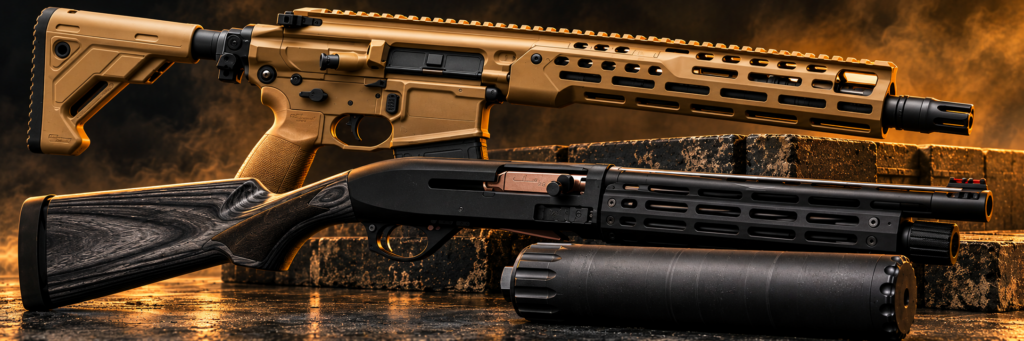
The covered items are suppressors, SBRs, SBSs, and certain AOWs. ATF says the $200 NFA tax remains for machine guns and destructive devices.
How the $0 tax stamp connects to the new policy
The enforcement announcement builds on a change that took effect earlier in 2026. Public Law 119-21 reduced the federal NFA making and transfer tax to $0 for covered items other than machine guns and destructive devices, effective January 1.
Initially, the tax went to zero while the ATF application and registration process remained in place. The October guidance goes further: ATF now says it will not enforce specified NFA approval and registration requirements for the covered categories. The agency continues to accept voluntary NFA applications and registrations. See ATF’s current NFA transfer guidance and FAQ
What this means for suppressors, SBRs, and SBSs
For gun owners, the practical headline is less federal NFA paperwork and fewer NFA-specific barriers for the items covered by ATF’s policy. Suppressors can help reduce noise exposure at the range or in the field. SBRs and SBSs offer compact configurations that some owners prefer for lawful sporting, defensive, or collection purposes.
In plain terms: the federal process has shifted, and owners should read the current rules before making a move. Check the details, know your state law, and keep it squared away.
What rules still apply?
ATF’s announcement does not mean every firearm rule disappeared. The agency says the Gun Control Act (GCA) and state and local laws continue to matter.
State and local restrictions
ATF’s guidance does not override state or local law. Some states restrict or prohibit possession of suppressors, SBRs, SBSs, or other NFA items. ATF also warns that state laws may require registration or otherwise treat an unregistered item differently. Check the law where you live and where you plan to travel.
Machine guns and destructive devices
The new non-enforcement policy applies to items for which Congress set the NFA making and transfer tax to $0. ATF says machine guns and destructive devices remain subject to the NFA’s taxes and requirements.
The policy could change
ATF warns that changes in the law or legal circumstances could lead to NFA enforcement resuming. The agency also notes that unregistered NFA items may face serious legal consequences if enforcement resumes and that federal law does not automatically provide grandfathering or later registration. Read the full ATF FAQ for its discussion of future legal risks.
Does “ATF will not enforce” mean these items are unregulated?
No. That phrase describes ATF’s current enforcement posture for specified NFA provisions. The items remain firearms under the GCA, and other federal requirements continue to apply. State and local restrictions also remain in force.
It’s a major policy change, but it’s not a blank check. Owners should verify current requirements before making, acquiring, transferring, possessing, or transporting a covered item.
Frequently asked questions
Is ATF still enforcing the NFA tax-stamp requirement for suppressors?
ATF says it will not enforce the NFA tax-stamp and related requirements for covered suppressors under its current policy. The NFA making and transfer tax for suppressors was reduced to $0 effective January 1, 2026. State and local restrictions still apply.
Does ATF approval remain required to make or transfer an SBR?
ATF’s October 2026 guidance says it will not enforce specified NFA requirements to apply for and receive prior approval before making or transferring covered SBRs. Other federal firearm laws and state restrictions still apply.
Can I cross state lines with an SBR or SBS without filing Form 20?
No. ATF says individuals must continue to obtain approval using Form 20 before interstate transportation of an SBR or SBS, even if the item is unregistered.
Are suppressors, SBRs, and SBSs unrestricted now?
No. ATF’s guidance concerns enforcement of specified NFA rules. GCA requirements, state and local laws, dealer rules, and transportation requirements continue to apply.
Does the new policy apply to machine guns?
No. ATF says machine guns and destructive devices remain subject to NFA taxes and requirements.
The takeaway for gun owners
ATF’s October 2026 guidance is a major development for suppressors, SBRs, and SBSs. The agency says it will no longer enforce specified NFA approval, registration, and tax-stamp requirements for covered items, following a court ruling and DOJ’s decision to extend the enforcement policy.
That means less federal NFA red tape under ATF’s current posture—but owners still need to follow applicable GCA rules, state and local laws, and transportation requirements. Before acting, read ATF’s full guidance and FAQ and verify the rules for your location.
This article is for general informational purposes and is not legal advice. ATF guidance, court orders, and laws can change.