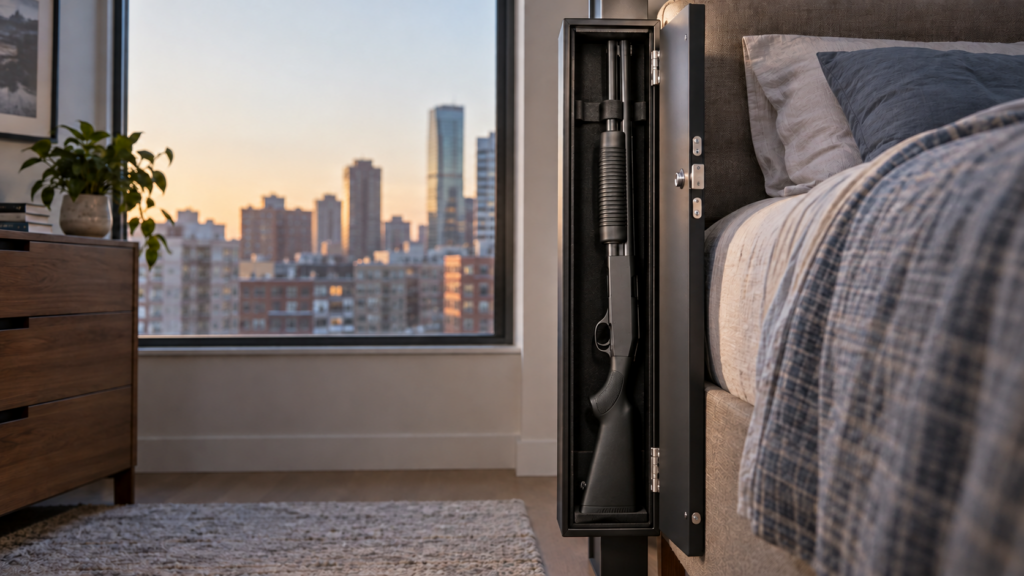
A shotgun has a certain presence. It’s familiar, powerful, and deeply rooted in America’s tradition of lawful self-defense. But when the conversation turns to protecting a home—especially an apartment or a house packed close to the neighbors—confidence needs to come with clear-eyed responsibility.
A shotgun can be a reasonable home-defense choice for some people. It is not magic, it is not foolproof, and it is not automatically right for every household. Here’s a practical look at the tradeoffs.
The case for a home-defense shotgun
A shotgun can deliver substantial force. Defensive buckshot sends multiple projectiles with one shot. That does not make a shotgun a substitute for careful handling, training, or knowing what lies beyond a potential target.
It is a familiar platform for many owners. Shotguns are widely used for hunting and sport shooting. Familiarity can help, but only if it comes from safe, regular practice with the specific firearm.
There are several configurations and loads. Shotguns come in different gauges, action types, and capacities. The right fit depends on the owner, household, and firearm—not on a one-size-fits-all internet rule.
The tradeoffs: recoil, handling, and limited ammunition
A shotgun is a long firearm, and moving it safely through a cramped home can be challenging. Recoil can be substantial, particularly with some 12-gauge loads. Smaller or less experienced shooters should consider whether they can operate and control the specific firearm reliably.
Capacity is another real limitation. Many shotguns hold fewer rounds than many commonly discussed defensive firearms, and reloading takes time and attention. Capacity varies by model and configuration, so check the manufacturer’s specifications for the firearm you own. A plan built around the idea that one shot will end every emergency is a plan built around a fantasy.
Shotgun penetration: walls are not a safety system
“Shot spreads out” is not a safety plan. At typical indoor distances, a shotgun pattern may be much tighter than people expect, and pellets can still travel through interior building materials. Buckshot, slugs, and other loads behave differently, but drywall should never be treated as a reliable barrier.
Published ammunition testing often uses ballistic gelatin to compare performance under controlled conditions. Gelatin is useful for comparison; it does not predict exactly what a particular load will do in every home, wall, or building. Results vary with ammunition, firearm, distance, and construction materials. Testing by firearms publications has also shown that shotgun loads can penetrate drywall, reinforcing the need to account for other people and rooms beyond a potential target. FBI ammunition testing background, shotgun wall-penetration test
That matters even more in urban neighborhoods, multi-family buildings, and homes with thin interior walls. Know the layout of your home. Consider who may be in adjoining rooms or neighboring units. No load turns an uncertain shot into a safe one.
Does the sound of a shotgun being racked make an intruder leave?
Sometimes a person may leave when confronted with a warning sound. But there is no guarantee—and a determined or confused intruder may react in an unpredictable way. The familiar “rack the shotgun and the bad guy runs” line is a story, not a dependable home-security strategy. A firearm’s mechanical sound does not identify who is in the home, establish what they intend, or ensure that they will retreat. Discussion of the racking myth
Treating the sound as a guaranteed deterrent can also encourage unsafe assumptions. A home-defense plan should account for communication, emergency services, safe storage, and the possibility that a situation may not unfold as expected. Don’t rely on a sound effect to do the work of judgment.

Is a shotgun right for your home?
The strongest argument for a shotgun is not that it is unbeatable. It’s that a particular owner may know the platform, be able to handle it safely, and understand its limitations. The strongest argument against it is that a shotgun can be difficult to manage in tight spaces, has limited capacity on many models, and can pose serious risks to people beyond the intended target.
For lawful gun owners, responsible home defense starts well before an emergency: learn the firearm, practice safely, understand local laws, and store it securely. The ATF recommends safe handling and secure storage, including keeping firearms locked away from children and unauthorized users. ATF firearm safety and storage
The Second Amendment protects a fundamental right. Exercising that right responsibly means seeing the shotgun clearly: capable, demanding, and only one part of a serious plan to protect the people who live around you.