Armed, Black, and still misread: gun ownership in america, 2026
Black gun ownership is often framed as a new political trend. It is not. For generations, Black Americans have sought firearms for protection in a country where the law has often denied them equal protection—and sometimes treated their self-defense as a threat. In 2026, more Black gun owners are visible in media and organized communities, but greater visibility has not erased the tension between a legal right to carry and the racial assumptions that can shape how that right is received.
A right repeatedly restricted
The history of African American gun ownership begins with exclusion. Enslaved people were generally barred from possessing firearms, while colonial and state laws restricted the arms of free Black people. After emancipation, Black Codes and other discriminatory rules constrained Black residents’ access to weapons. These restrictions operated alongside racial terror, including attacks by the Ku Klux Klan and other white supremacist groups. For many Black families, a firearm could represent a means of defending a home or community when authorities failed to protect them—or participated in the violence.
Armed self-defense continued through the civil rights era. Fannie Lou Hamer owned a firearm; Martin Luther King Jr. sought a concealed-carry permit after his home was bombed in 1956, but was denied. Groups including the Deacons for Defense and Justice protected civil rights workers, while the Black Panther Party made the right to bear arms part of its public advocacy. This legacy is not a single political position: Black Americans have held varied views on firearms and gun regulation, often shaped by personal experience and community safety.
What the numbers show—and what they do not
The clearest recent national comparison comes from Pew Research Center’s 2023 survey. About **24% of Black adults said they personally owned a gun**, compared with 38% of White, 20% of Hispanic, and 10% of Asian adults. The figures describe self-reported personal ownership, not household access, and should not be read as a count of all firearms or owners. Pew also found that **56% of Black adults who did not own a gun could imagine owning one in the future**, more than the shares among White, Hispanic, or Asian non-owners.
A 2026 qualitative study of Black Americans who acquired firearms during the early pandemic adds context rather than a new national ownership rate. It reports that Black respondents made up **21% of new firearm owners** in the study, compared with **9% of people whose most recent purchase was before 2019**. That finding points to a changed composition among recent purchasers in that sample; it does not mean that 21% of Black Americans own guns. Participants described varied motivations, including personal safety amid racial violence and distrust in institutions.
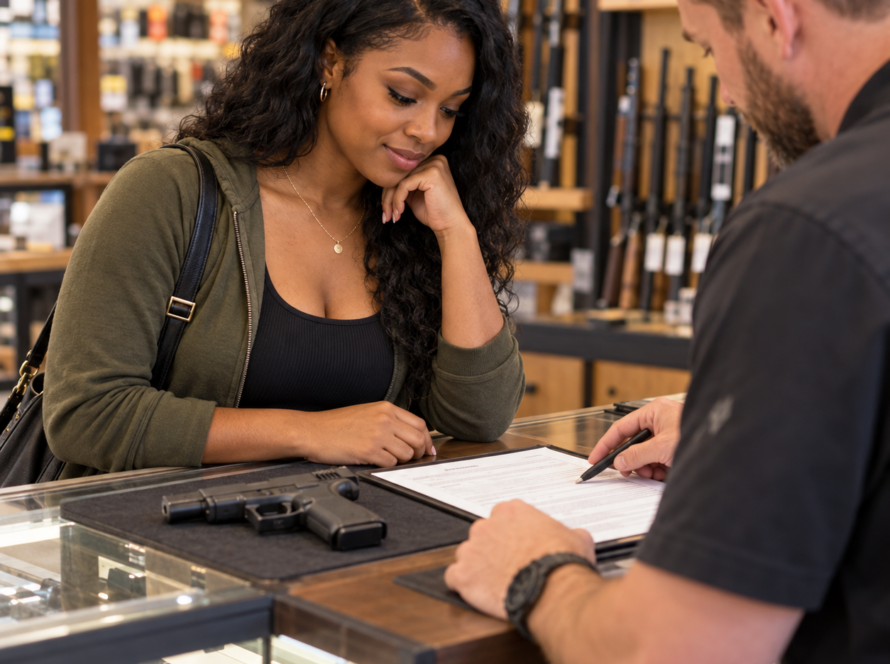
The broader shift is therefore both measurable and cultural. Black gun owners have become more visible through groups such as the National African American Gun Association, community training, journalism, photography, and social media. Projects like Christian Lee’s *Armed Doesn’t Mean Dangerous* challenge the stock image of an armed Black person as inherently criminal. Visibility can broaden the conversation, but it does not prove that stigma has disappeared—or that all Black gun owners share the same reasons for owning a firearm.
The law-enforcement dimension
For Black gun owners, a police encounter can carry an added risk: officers may interpret the same fact—someone is armed—through racialized expectations about danger. That concern has a history and remains visible in cases such as Philando Castile, a licensed gun owner killed by a Minnesota police officer after telling the officer he had a firearm, and Roger Fortson, a Black U.S. Air Force airman killed by a Florida sheriff’s deputy in 2024 after answering his apartment door while holding a gun. These cases are not interchangeable, and an individual case cannot establish a national pattern by itself. They show why lawful ownership does not guarantee that an encounter will be perceived as ordinary.
Research on policing documents racial disparities in stops and use of force, but **national data do not neatly isolate lawful Black gun owners’ encounters with police**. It would overstate the evidence to claim that a single statistic measures their specific risk. A 2024 Associated Press investigation, for example, found that Black people accounted for about one-third of more than 1,000 deaths after police used force not intended to be deadly over a decade, despite representing about 12% of the U.S. population. That is evidence of a broader disparity in police force, not a gun-owner-specific rate.
This distinction matters. The relationship between gun ownership and policing is not simply that carrying a gun causes a bad encounter, nor that ownership guarantees safety. It is shaped by local laws, the circumstances of an encounter, officer decisions, and the unequal ways Blackness and armed presence can be interpreted. Responsible ownership includes learning applicable state and local rules, secure storage, training, and understanding that laws on carrying and disclosure vary by jurisdiction. Those precautions cannot remove structural bias, but clear information can help people make informed choices.
The stigma has shifted, but not vanished
In 2026, Black gun ownership is harder to dismiss as an anomaly. National survey data, new research, advocacy groups, and first-person storytelling have made Black owners more visible and their motives more legible: protection, sport, family tradition, community, or a mix of reasons. That visibility has also complicated the old assumption that gun rights belong most naturally to White Americans.
Yet the gap between formal rights and lived experience persists. Black Americans’ history with firearms includes both state-imposed disarmament and armed resistance; today it includes new buyers, longtime owners, public debate, and unequal encounters with law enforcement. Seeing Black gun owners as individuals—rather than symbols of danger or political talking points—is a necessary starting point for an honest conversation about rights, safety, and equal treatment.